Popular Posts

Tuesday, February 8, 2011

Why do the blog? Re-Posted


"When you are not actively involved in pursuing
 what you want, you end-up getting what you get!"
                                                                                                                  -- Vince DelaRosa

Oneida, WI - This blog will focus on issue relating to the Oneida Tribe of Indians of Wisconsin.  I author this blog in the spirit of those that desire a different perspective on some of the issues of the day. 

What I actively want to pursue is to ensure that our government will abide by the doctrine, and live by the duty, that it will be responsive to the needs of the people. We see on the federal level, a government that is completely out of control. We cannot be that way. The people's interest and will must be at the center of all we do!  

At its core, Oneida, WI and the Oneida Tribe is a wonderful place to raise a family and work. We have quite a unique history. However, Oneida is not without its challenges. Just like any other community, policies, opinions, politics and government can clash, but there can always be a middle ground and a meeting of the minds.  This is what I aspire to do, offer middle ground thoughts and propositions on things that most people shy away from talking about. My opinions are based on my experiences as an Oneida tribal member, and as a former Councilman with the tribe.

I am fascinated by the shifting landscape of politics that goes on here in Oneida. For the better part of the last two years, I have remained below the political radar. I had great hope for the new government. I did not want to interfere. So as the time in this term has evaporated, my hope has turned to questions about a variety of decisions that have been made over the last two and a half years. I will share some of those thoughts in the pages of this blog. 

Most profoundly etched in my mind is the idea that someone should share some independent thoughts on some of the serious policy questions of the day.  I have read our tribal newspaper over the years hoping to get a feel for what is going on. I hear much, and I monitor policy issues, but I do not see the newspaper reporting strongly enough on major policy issues. 

The idea for this blog is born out of the concept that the Oneida people have great minds that can be used to form their own opinions. In most societies newspapers rigorously probe government and share various perspectives on the issues of the day. In Oneida, I do not see that occurring. This is a needed part of any society that has a functioning government. So my blog will do its part to shed some light and hopefully help illuminate just some of the issues of the day.

My review of issues will be as time permits because I cannot be everywhere covering all issues, so I offer this to my readers. If you see important issues on policy questions, please feel free to send me and e-mail and I will do my best to probe at issues which my readers might find interesting. Here is my e-mail: oneida2011@yahoo.com

Just as a side note, some of the issues that I am concerned with are outlined below here:

 
* An Annuity Per-Capita Plan    

* Fair Employee Wages
* Responsible Governance Bills                                

* Small Business Funding 
* Test For Public Office                                               

* Governmental Reforms 
* Tighter Fiscal Controls                                              

* New Education Policy                     
* Unique Health-Care Solutions

* TV Cameras in all OBC Meetings                       
* Building Homes                                              
* Enhanced SEOTS Programming                                
* Technology Advancements                                    
* Welfare Programs for Unemployed


Here are some overarching themes and questions that I have:

1.) Tribal Wages:                 
- "Big Salaries & Why Aren't the workers Making those Salaries"

2.) Housing Issues:                  
-  "So Much Money - So Few Houses?"

3.) Service: 
-  "Where is the Food Pantry?" - Is anyone helping Oneida's who have lost jobs?

4.) Government/Policies:                
-  "Whose Guarding the Hen House?"

5.) Path Ways To Change:            
 -  "Merchants of Change - The GTC"  

 -  "GTC Needs More Authority" - Budget / All Spending
 -  "How Can We Strenghten GTC's Role?"

Respectfully,
Vince DelaRosa

Friday, January 28, 2011

The Day - Mashantucket tribe's top judge ousted, says he wasn't told why | News from southeastern Connecticut

"If you're going to be a sovereign, you've got to act like a sovereign. That does NOT include removing judges just because you don't happen to like a decision they make. Tribal courts are not supposed to be the lap dogs of tribal councils/legislatures or tribal chiefs. There seems to be a number of tribes these days that have forgotten that (kindly take note, Tribal Council of the Muscogee (Creek) Nation)." - - - Timothy Pleasant, Native American Law Blog

SEE THE LINK HERE: The Day - Mashantucket tribe's top judge ousted, says he wasn't told why News from southeastern Connecticut

Tuesday, January 25, 2011

Monday, January 24, 2011

Wages and Food Prices = Impact Quality of Life

Wages and food cost can impact people lives.

By Vince DelaRosa


Oneida, WI - Over the last year and a half I have heard a lot of people expressing concerns with their wages. Recently, I wrote about how we (Oneida) have a $479,172,033.00  million dollar budget but there is no room for wage increases for the employees. One of my main concerns with stagnant wages is the reduction is peoples buying power. Whether it's gas in the tank or items for the dinner table, everything is going up in prices while wages are flat.

Here is a little eye opening fact regarding minimum wages. Look at the inflation-adjusted value for minimum wages as outlined below: 


For some of us, our grandparents had more spending power earning minimum wage four decades ago, then some of us today, I know that is hard to believe. According to calculations by the Economic Policy Institute, when adjusted for inflation, the minimum wage in 1968 was worth $8.54 per hour. The current minimum wage is $7.25 per hour in Wisconsin.

The value of the minimum wage has risen in the last few years, following a three-year government effort to boost the lowest allowable hourly wage in the United States. The final stage, which took effect in July of 2009, brought the minimum wage up nearly 11 percent to its current rate. These are issue that we have to look at here in Oneida, WI.


Remember, when I did my work on wages issues, which included a GTC petition, we laid the ground work to build a progressive system. Now when revisions to my work came around, I wanted to address some of these matters, but I was never given the opportunity. Today the tribes wage project, which was know as Valiant in 2008, that needs to be revisited. 

Now I will say, we can do as we please with our wages, especially if we could ever get control of spending. In some states for example, there has been mandates that allowed minimum wages to be paid at a higher rate than the national rate. Those are states where they are trying to look out for their people.

But the truth is the value of the minimum wage has not, in the long-term, kept up with rising inflation cost, which boosts what things cost and lowers the value of money. (For more fun with inflation, check out this inflation calculator from the Bureau of Labor Statistics.)

Millions of workers across the country are earning wages at or below the minimum wage, look here for more information: Bureau of Labor Statistics. Its' believed that nearly 5 percent of all hourly paid workers are under paid.

Grocery prices are going up! 

Now with all this said on wages, over the last several years, as you may have noticed, food prices have begun to soar. Not only at high end grocery stores such as Whole Foods but even at chains such as Safeway, Sam’s Club and Costco.

The rise in food coast have been fueled by trends in the global demand for food and the costs involved in supplying it, finding cheap food is becoming almost impossible. That why I think a vibrant Oneida Food Pantry is so needed.

To illustrate the huge jump in food prices, look at commodities cost for items such as wheat and rice. Between 2005 and 2008, average world prices for rice rose by 217%. As it pertains to wheat, the recent droughts and wildfires in Russia caused the government to ban grain exports for the remainder of the year, which in turn caused wheat prices worldwide to spike. Although the recent downturn in the economy took pressure off rising food prices as demand decreased slightly, rising incomes all over the world and increased food consumption, particularly in China and India. This has resulted in a new demand/supply equilibrium: prices have adapted upwards. According to the U.S. Department of Agriculture, food prices are expected to increase by 3% to 4% based on increases in supermarket prices of 2.5 to 3.5 percent.


Increasing food prices can in part be attributable to an increase in the costs of inputs required to produce food such as energy, land, seed and fertilizers. Several years ago, the U.S. and Europe began promoting ethanol research, giving farmers financial incentives to sell corn and other crops for use in biofuels. However, corn ended up being used to try to help cars run more efficiently rather than in the production of food. As a result, there is less corn product to meet customer demands for consumable corn.


Corn is used in so many grocery store foods and is also fed to dairy cows, hens and cattle. The growing demand for the corn crop has sent a ripple effect into every aisle of the supermarket, even in Oneida we feel the pain at the register.

Additionally, the increase in oil prices in recent years, has also affected the way that food is produced and priced. Operating heavy machinery has become more expensive, as has the price of fertilizers and shipping products from one place to another. As production costs increase, commodity prices such as wheat and rice must trade higher to ensure that farmers continue to make a profit. This cost ultimately has to be passed on in the final price of food. Trade also plays a role in rising food prices. In an attempt to give domestic markets a competitive edge, governments are limiting free trade and placing tariffs on imported or exported goods. The ultimate goal is to prevent a food shortage at home but its causing food prices globally to increase by hindering free trade.

Well as you can understand, there are many factors leading to the increase in food prices. Developing nations are making attempts to become self-sustainable and decrease their dependence on foreign food sources. Governments and global organizations are also adjusting ethanol subsidies, tariffs, and trade restrictions to reduce food shortages. On the consumer end, consumers must commit to making changes in their diets so that food distribution can be more equal globally. This is no easy task and one that will take years to achieve, if ever. Honestly, many of these factors probably make no sense to us here, but they do impact us. Just look at the prices at Walmart, Festival or Copps, all going up.

Likewise, when we couple this with shrinking wages, wage freezes and no cost of living adjustments, this can spell out some tough times ahead of us. I think one of the most important issues here in Oneida on issues such as these, we really have to try and re-shape some of our priorities, especially around low to mid-level wages. 

Saturday, January 22, 2011

Top 1 Percent Control 42 Percent of Financial Wealth

Top 1 Percent Control 42 Percent of Financial Wealth in the U.S. – How Average Americans are Lured into Debt Servitude by Promises of Mega Wealth.

By Mybudget360


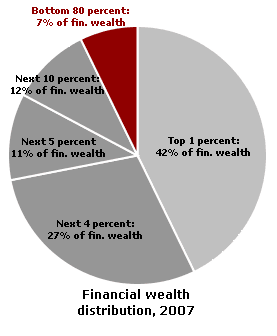
USA - Many Americans are not buying the recent stock market rally.  This is being reflected in multiple polls showing negative attitudes towards the economy and Wall Street.  Wall Street is so disconnected from the average American that they fail to see the 27 million unemployed and underemployed Americans that now have a harder time believing the gospel of financial engineering prosperity.  Americans have a reason to be dubious regarding the recovery because jobs are the main push for most Americans.  A recent study shows that over 70 percent of Americans derive their monthly income from an actual W-2 job.  In other words, working is the prime mover and source of their income.  Yet the financial elite have very little understanding of this concept.  Why?  42 percent of financial wealth is controlled by the top 1 percent.  We would need to go back to the Great Depression to see such lopsided data.


Many Americans are still struggling at the depths of this recession.  We have 37 million Americans on food stamps and many wait until midnight of the last day of the month so checks can clear to buy food at Wal-Mart.  Do you think these people are starring at the stock market?  The overall data is much worse:

financial-wealth-united-states

Source:  William Domhoff


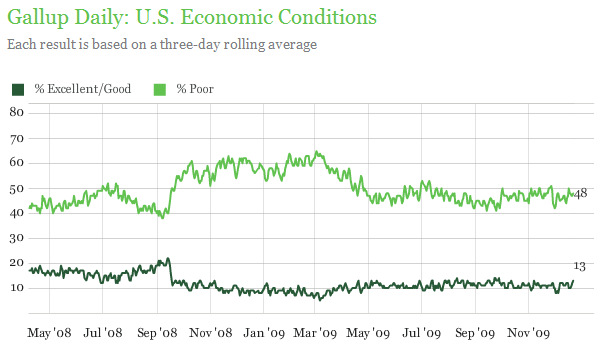
If we break the data down further we will find that 93 percent of all financial wealth is controlled by the top 10 percent of the country.  That is why these people are cheering their one cent share increase while layoffs keep on improving the bottom line.  But what bottom line are we talking about here?  The Wall Street crowd would like you to believe that all is now good that the stock market has rallied 60+ percent.  Of course they are happy because they control most of this wealth.  Yet the typical American still has negative views on the economy because they actually have to work to earn a living:

gallup-economics

The above daily poll asks Americans about their view on the health of the economy.  Only 13 percent believe the economy is good or excellent.  Funny how that correlates with the top 10 percent who control 93 percent of wealth.  Many Americans were sold the illusion of the bubble.  They were sold on the idea that their homes were worth so much more than they really were.  And many used this phony wealth effect to go out and spend beyond their means.  They started spending as if they were part of this elite 10 percent crowd.  But once the tide rolled out, it was clear they were not.  And the horribly built bailouts demonstrate who is controlling our political system.  This was not the rule of a capitalist system but a corporate run government.

Just think about the bailouts and which companies were saved.  We ended up bailing out the worst performing and troubled companies thus keeping alive companies that should have completely failed.  Did we bail out Google?  Proctor and Gamble?  Of course not.  These companies actually produce something that people want.  Banks and especially the Wall Street kind merely keep that 42 percent happy by making sure their stock values stay high so they can keep on making money while the average Americans is sold up the river.

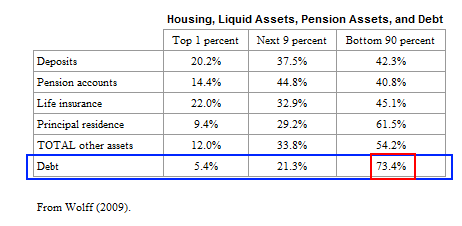
Yet many were brought into the easy money fold by going into massive amounts of debt.  And who has most of the debt?  That is right, the average American:

debt

The bottom 90 percent have been saddled with 73 percent of all debt.  In other words much of their so-called wealth is connected to debt.  Debt is slavery for many especially with egregious credit card companies taking people out with absurd credit card tricks and scams.  Yet the corporate propaganda machine is strong and mighty.  Have you ever received an inheritance?  A large one?  Probably not because only 1.6% of all Americans receive an inheritance larger than $100,000.  If this is the case, why in the world do politicians worry so much about the tax impacts of this?  Because they want to keep the corporatocracy alive and well so their spawn can get a piece of their pie.  They give the illusion to average Americans that if you only work hard enough you too can join this elusive club of cronies.  The data shows otherwise.

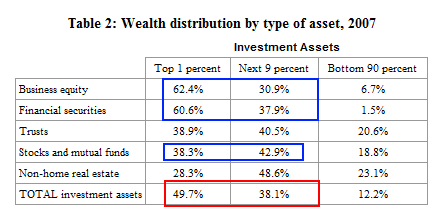
But if we start looking at investment assets, the true wealth in the country, we start realizing why Wall Street is all giddy about the recent stock market government induced rally:

stock-markets

Of investment assets 90 percent of Americans own 12.2 percent.  The rest goes to the top 10 percent.  Welcome to the new serfdom.  The bailouts that went out to the filthy rich were more about protecting their tiny corner of the world than actually making the economy better.  That is why it is interesting to see companies fire people and Wall Street cheer for the increase in earnings per share.  Good for the few at the expense of the many.  Yet the propaganda out of Wall Street and our government is what is good for Wall Street is good for you.  Just like that 1.6% inheritance issue, the vast majority of Americans won’t deal with that and their primary concern is simply a job.  A job that has provided stagnant wages for a decade while the ultra wealth get richer and richer in a phony form of corporate socialism.

If you break down the data you realize that most Americans don’t have time to speculate in stock markets:

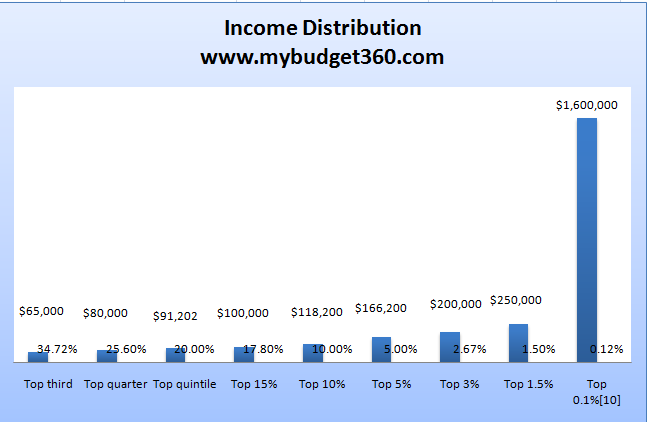
incomedistribution

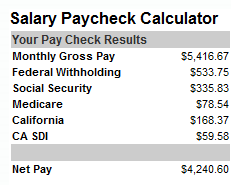
Only 34% of U.S. households make more than $65,000 per year.  What is that after taxes?  Let us use a state like California for example:

income

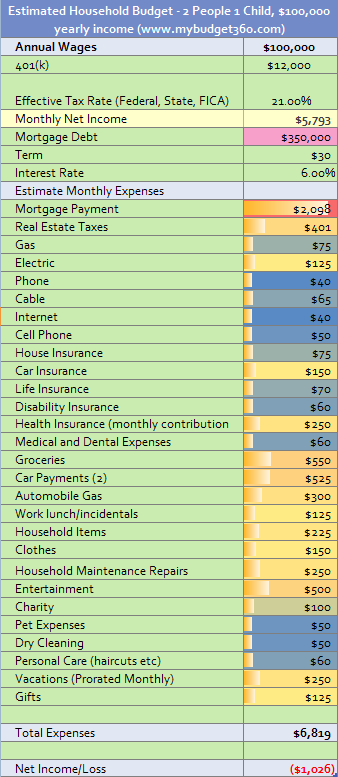
Now if we breakdown this data further you will realize that most of the money is consumed by cost of living necessities, not Wall Street speculation.  Just to show this example let us look at a family budget for someone in California making $100,000:

family-budget-100k

Notice after running the budget we are in the hole for $1,000?  That is because of many costs that typical families have.  We can debate the merits of where they are spending money but the point is this; are these people really making beaucoup money from the stock market?  They are putting away $12,000 a year into their 401k.  As we have now found out, 8 percent a year is never guaranteed in the stock market although the corporate powers would like you to believe that so they can have other suckers to unload stocks onto.
“Yet the median household income in the U.S. is $50,000 and not $100,000.  They have even less to invest.”
They are more concerned on working to have a paycheck to pay for necessities.  They are more concerned about paying their house off by the time they retire and hopefully, have a little bit of retirement funds coming in.  The sad fact is most Americans rely on Social Security when they retire.  All those ads of unlimited golf and daily trips to Tahiti are propaganda of how Wall Street lives and they want to sell you the sizzle, and clearly not the steak.  They live their lives paper pushing and sucking the life out of the productive part of our economy. 

The average American should now realize this since this financial crisis was primarily caused by them.  They are now on a massive campaign to blame Americans for this.  This is hypocrisy to the next level.  Many Americans have paid for their mistake by losing their home through foreclosure.  We have 300,000 foreclosure filings a month.  Many have taken a hit to their overall stock portfolio (if they have one).  Yet the corporate cronies have protected their horrible economy crushing debts at the taxpayer expense.  Unlike you, many hold bonds on the companies and not common stock like many Americans.  Bondholders have been protected at all costs during this crisis.  Goldman Sachs through AIG received 100 cents on the dollar for their horrible bets.  The banks have unlimited back stops thanks to taxpayers.  This is how the top 1 percent rule the new feudal state.

Welcome to the 2010 serfdom.  Time to wake up and restructure the system.  Many people are starting to wake up to this massive scam.

Reprinted from Mybudget360

Friday, January 21, 2011

The Unemployment and Jobless Recovery Myth

The Middle Class Destruction through Unemployment Corporate Jargon.

By Mybudget360


USA - It is amazing how many financial analysts usually from the too big to fail banks have gone onto the media circuit to claim that employment is always a lagging indicator in economic recoveries.  They preach this belief as if it were a law like thermodynamics.  These same people who never envisioned a stock market collapse rivaling the Great Depression now want the public to believe their flawed doctrine of economic prosperity.  Yet the question is prosperity for who?  How are we supposed to trust an industry filled of self-labeled experts that missed the biggest financial crisis in modern times?  This is like a pharmacist who doesn’t know what drug to give you or a baseball player who can’t swing a bat.  We can’t trust Wall Street for a variety of reasons including they are part of the nucleus for this economic calamity.


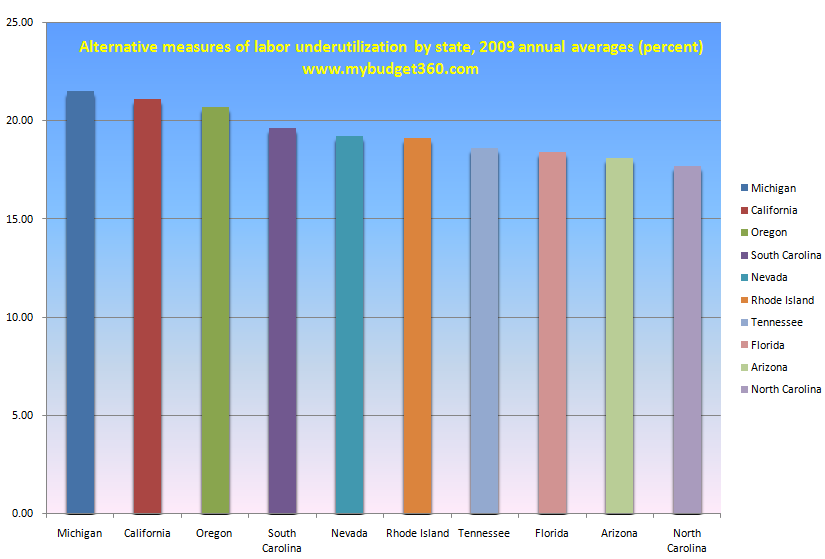
It is amazing that we even have to debate the issue of employment.  Our economy cannot function and provide the middle class a thriving environment without jobs.  This should be obvious yet the Wall Street crowd is feeling comfortable even though the public is still dealing with double-digit unemployment (we’ve lost jobs for 24 straight months and would have to go back to the Great Depression to find a similar streak).  In fact, the largest state economy in our nation that of California with an economy of over $1.8 trillion managed to average out an underemployment rate of 21.1 percent for all of 2009:


Source:  BLS

This chart is downright troubling.  Who would have thought that Michigan and California would lead the way in 2009 with underemployment rates over 21 percent?  Michigan has had issues for many years and their economy pulls in a GDP of $380 billion.  But California being the biggest economic state in our country with a GDP of $1.8 trillion should make you pause before you think we are somehow in recovery mode.  And from the looks of it, California with their historical housing bubble looks to have years of financial trouble to work through.  These issues are large and we haven’t even begun examining their state budget issues that are projected to come in at $21 billion.

Having a job is the cornerstone of our economy and also our vibrant middle class.  This has been the case for multiple decades and actually has been part of our identity since the disastrous years of the Great Depression.  Having a job is a pact with our country and Wall Street has taken this for granted in the last thirty years.  Slowly we moved from an economy that valued work to a casino like economy that funneled money into Wall Street and whatever demand came after the spending of the corporatocracy was given as crumbs to the public.

This notion of “jobless recovery” is such an oxymoron.  How can we have a recovery while losing 8 million jobs?  Just because bank bonuses are back to record breaking levels does not mean a recovery is in place.  Statistically we can massage the numbers however we like.  And what else would you expect?  We pumped $14 trillion in bailouts, backstops, and gifts to bankers so of course something was bound to happen.  Even a mountain can move with enough force.  Yet where are the jobs?

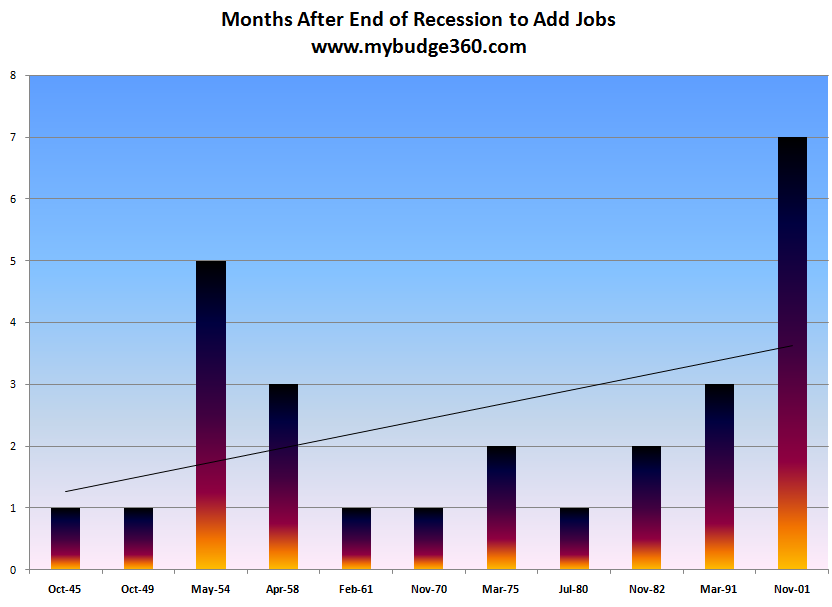
We should examine job gains after previous recessions to see the erosion of our middle class base:


Source:  NBER

The above chart marks the month ending of all recessions since 1945 and how long it took to have a net positive month in job gains.  For the most part, jobs were added fairly quickly and in many cases the month right after the official end of the recession.  But starting in 2001 we start noticing this shift to the jobless recovery era.  Now why did this occur?  Well for previous recessions the business cycle was easy to follow and track.  The economy pulled back and so did employment.  But once the economy got back on track demand followed and so did employment.   But since the banking oligarchs have taken over our economy, a gain in the economic indicators does not mean additional employment.  Since we now are largely importers we can buy cheap goods but have dismantled our goods producing base.   Ask yourself this, where did banks make their profits in 2009?  It definitely wasn’t because employment boomed.  Demand has been mute.  So where did it come from?  The profits came from gambling on exotic financial instruments all over the world with taxpayer money.  In other words, the recent stock market rally is artificial and no longer represents the economic reality for most Americans.

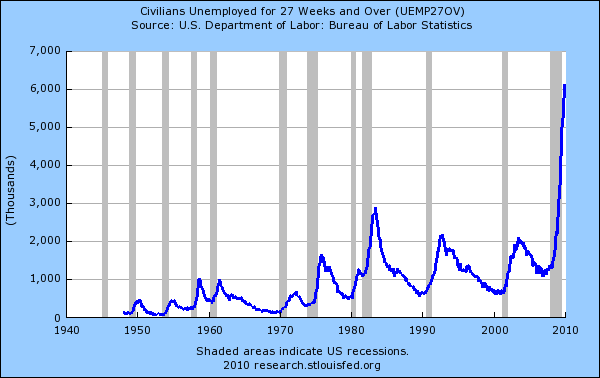
Another key indicator to look at is long-term unemployment:


It is amazing that the largest group of unemployed Americans falls under the long-term unemployed category.  Over 6,130,000 Americans fall in this group.  These are people that have been out of work for at least 27 weeks and will most likely, need to find a job in a different industry.  We’ve discussed this in previous posts that the groups that took the biggest hits in this recession are manufacturing and construction.  The financial industry has contracted as well but nothing compared to what other sectors have.  The above chart should be indicative of where we are.  This recession may be over in terms of GDP increasing but remove the bailouts and the stimulus and you get a deep economic mess.  Plus, we have yet to add any net jobs.  Think about this, we’ve added some $14 trillion in bailouts and backstops and we have yet to add a net job in the economy.  Is this really the reflection of a healthy economy?

The middle class since the 1970s has seen their savings dwindle, their work week increase while their pay lags, and the cost of necessities like housing and healthcare zoom past any income gains.  Even with two income households many Americans are simply trying to make ends meet.  Even those who are doing well, those making enough to be hit with the Alternative Minimum Tax (AMT) are feeling the pinch as well.  Because in reality, the last decade has been a gift to the top 1 percent of the nation.  Think about how taxes play out.  Many of these people live off capital gains that are taxed at 15 percent while even a physician working 70 hours a week will need to pay the top federal tax bracket of someone actually working.  In other words, our system values people who put their money into the casino as opposed to working.

How else can we explain the cheerful smiles of Wall Street traders while the nationwide underemployment rate is up over 17 percent?  How else can we explain the giddiness of bankers counting their bonuses while home values are still in the dumps for most Americans?  The continuous chants of “jobs lag the stock market” are absolutely tiresome and in fact, wrong.  The current system is only waiting like a beggar hoping Wall Street creates enough demand so most Americans can get a piece of the action.  We already saw what this creates with the housing bubble.  You can enjoy the ride for a few years but you’ll be kicked out once the fun is over.  While the public gets kabuki theater programs like HAMP bankers get bailed out 100 cents on the dollar like Goldman Sachs did through the AIG gift exchange.  In other words, this bailout isn’t for you and it certainly isn’t about creating jobs.

There is this argument about global bubbles.  Gold bubbles, a China bubble, another stock market bubble.  But take China for example.  Even though they are spending enormous amounts of money they have pumped billions into infrastructure projects that are at least building up their economy and putting people to work.  Engineering analysts for the U.S. estimate that we have about $2 trillion in infrastructure upgrade projects that we have delayed or simply ignored.  Why not take some of that $14 trillion and put it to at least reinforcing that core of our economic structure?  I’m not talking about building strip malls and dumping more money into the commercial real estate pit.  How about reinforcing our highways, bridges, universities, and other key components that make our economy strong and envied around the world?  If we are going to spend at least spend in the right place.

Yet the irony of this is the Wall Street system still believes in a “free market” world yet they’ve never even lived in anything resembling a free market.  Their idea of financial innovation is setting up credit cards with 79.9 percent interest rates and creating mortgages that harm your financial health when you’re not looking.
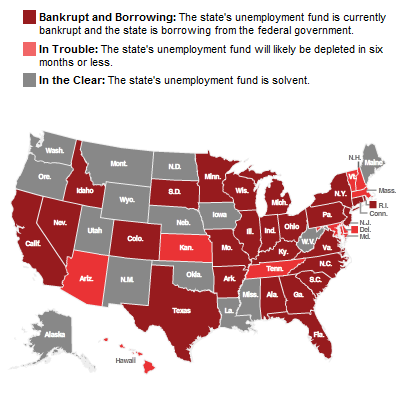
People are focusing on places like Greece, no doubt a big problem but California has an economy that is 13 percent of U.S. GDP!  Michigan has a bigger GDP than Greece ($357 billion) yet so much attention is being given to this issue.  Our nation’s number one GDP state has an underemployment rate of 21 percent and is on the precipice of financial insolvency.  Not only California, but other states.  In fact, many have been borrowing for their unemployment insurance funds trying to keep those long-term unemployed from going into despair:


Source: Propublica

Four enormous GDP states in California, Texas, Florida, and New York have bankrupt unemployment insurance funds and are now borrowing from the federal government who is also broke (not broke enough to bailout Wall Street however).  How anyone can look at the above and claim we are in recovery is really beyond me.

Reprinted from Mybudget360

Did you ever wonder: "How Much Does The Average American Make?"

How much does the Average American Make? Breaking Down the U.S. Household Income Numbers.

By Mybudget360


USA - How much does the typical American family make?  This question is probably one of the most central in figuring out how we can go about fixing our current economic malaise.  After all, we don’t hear many people saying in today’s world that they have too much money.


The median household income in the United States is $46,326.  In California, for example, people have a hard time understanding that yes, 50 percent of our population live on $46,000 or less a year.  Even today, all the elixirs and remedies being thrown around fail to focus on income and the big brother of income, solid employment.  Dual earner households have a higher median income at $67,348.

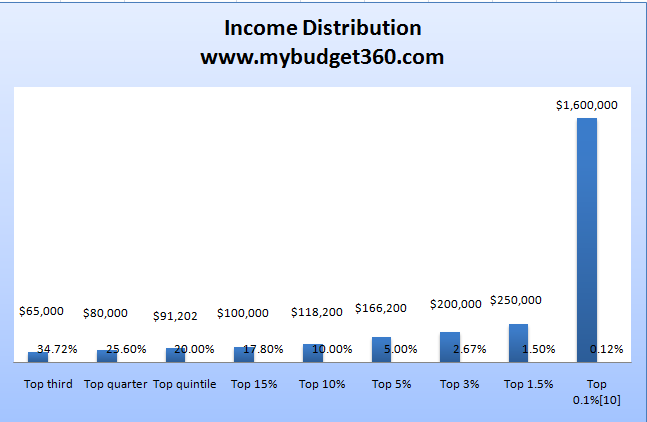
To highlight the massive discrepancy I’ve put together a chart showing the household income distribution:

U.S. Income Distribution

As you can see from the above chart, only 17.8% of all U.S. households make more than $118,200 a year.  Only 2.67% make more than $200,000.  The fact that only 34% make more than $65,000 is astounding given how expensive other cost of living items have gotten over the past decade.  That is why the middle class is feeling squeezed from all different sides.

When I put together a budget for a family making $100,000 I received a bit of feedback on both sides.  Even though I realized very few people had household incomes in the 6 figure range looking very closely at the data, I can understand why people took issue with a budget that was at that level.  I also put together a budget from someone living in California making $46,000 a year and received feedback as well.  I think
when it comes to income, you can never have too much.

What is even more fascinating, is how even amongst the super wealthy income is not distributed evenly.  There are approximately 146,000 (0.1%) households with incomes exceeding $1,500,000 a year.  Even at that, the top 0.01% of households had incomes of $5,500,000 and accounted for 11,000 households.  The 400 highest tax payers in the nation brought in a stunning $87,000,000 a year.  Now that is wealth.
For us mere mortals, it is important again to focus on that chart.  $46,000 does not go a long way.  In a recent Census report there are 110,000,000 households in the United States.  What this data tells us is that 55,000,000 households are living on $46,000 or less a year.  Let us assume this is a married couple with 1 child.  Let us run the numbers:

Texas Income Household

I ran the numbers for a state with no state income taxes, Texas.  A family at this level is only bringing in $3,215 a month.  The national median home price peaked around $200,000.  So let us assume this family purchased the median home:

5% down payment:         $10,000

Mortgage 30-year fixed (6.5%):   $1,200

Taxes and Insurance:     $333

PITI:  $1,533

Right off the bat, this family is spending 47% of their net pay on a median priced home.  We didn’t even account for any pre-tax retirement account investing.  Given the recent stock market performance and the loss of $50 trillion in global wealth, maybe that wasn’t such a bad idea.  The bottom line is the average American family is being squeezed from every angle.   What we need is a focus on jobs and our economy, not bailing out banks.  That defeats the entire purpose.  The average American family is struggling getting by and when they hear about these billion dollar handouts, they can’t help but to feel left out.

Reprinted from Mybudget360